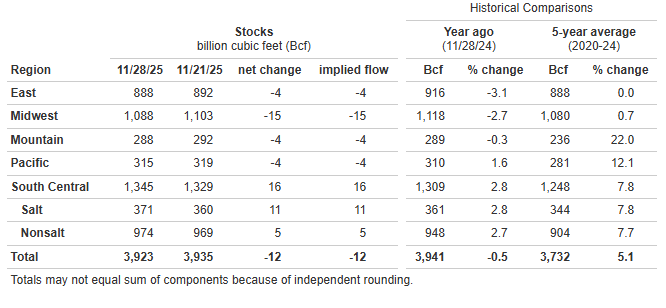
EIA Natural Gas Storage as of 11/28/25, as reported 12/04/25
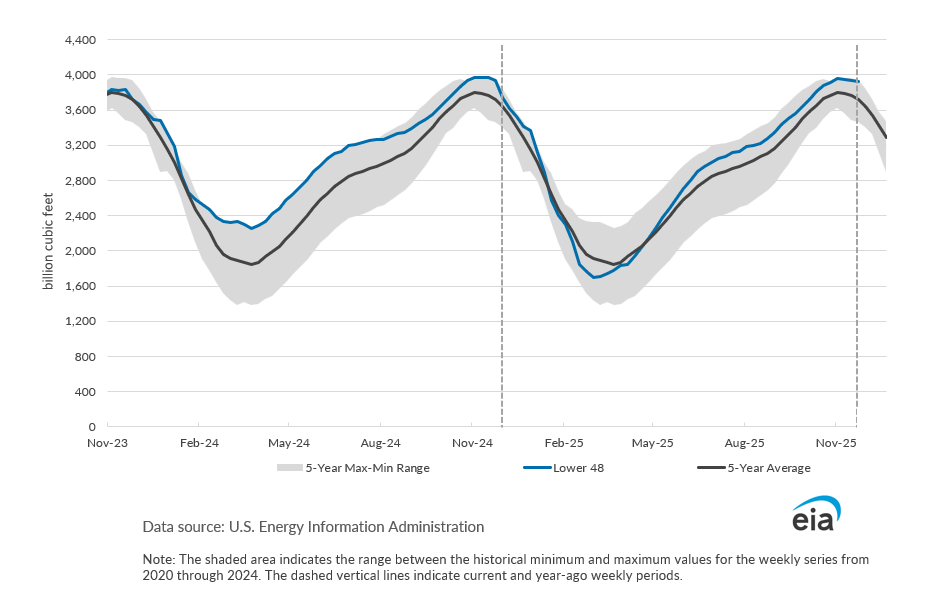
*Working gas in storage was 3,923 Bcf as of Friday, November 28, 2025, according to EIA estimates. This represents a net decrease of 12 Bcf from the previous week. Stocks were 18 Bcf less than last year at this time and 191 Bcf above the five-year average of 3,732 Bcf. At 3,923 Bcf, total working gas is within the five-year historical range.
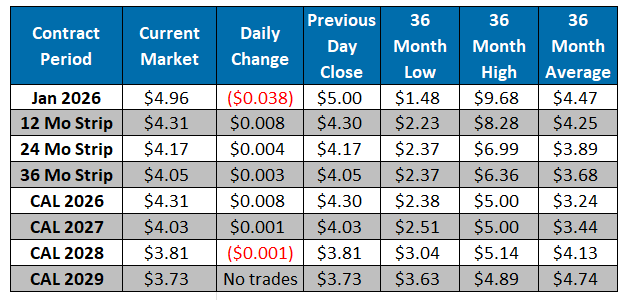
The NYMEX January contract closed at $4.96/MMBtu yesterday, a $0.16/MMBtu increase from Tuesday’s close. This week, January has averaged $4.93/MMBtu, around $0.25/MMBtu above last week’s average of $4.68/MMBtu. It is trading at $4.96/MMBtu, down $0.04/MMBtu from the previous day’s close. Natural gas prices held within a narrow range as traders weighed strengthening winter weather against a still-robust supply backdrop. L48 production remains elevated at 108.2 – 108.7 Bcf/d, with higher Haynesville volumes offsetting modest WoW declines in the Permian, keeping output more than 6 Bcf/d above year-ago levels. LNG feedgas demand is exceptionally strong near 19.2 Bcf/d, and with CC Stage 3 estimated to be taking in 0.8 – 1.0 Bcf/d, overall export flows remain near record highs. ResComm demand has climbed above 50 Bcf/d as much colder than normal temperatures spread across the East and MW, though brief moderation is expected before a renewed surge in heating loads later next week. Weather model guidance has added meaningful HDDs over the past 24 hours, and colder than normal conditions are expected to persist across the northern half of the country through mid-December. While strong production and above-average storage continues to cap the upside, record setting LNG demand and increasingly bullish December weather trends are keeping the January contract trading in the upper-$4/MMBtu range as the market looks toward deeper winter draws in the weeks ahead.
*Source: U.S. Energy Information Administration (EIA) Weekly Natural Gas Storage Report
Working Gas in Underground Storage, Lower 48
Working Gas in Underground Storage vs. 5-Year Maximum and Minimum
Current Market