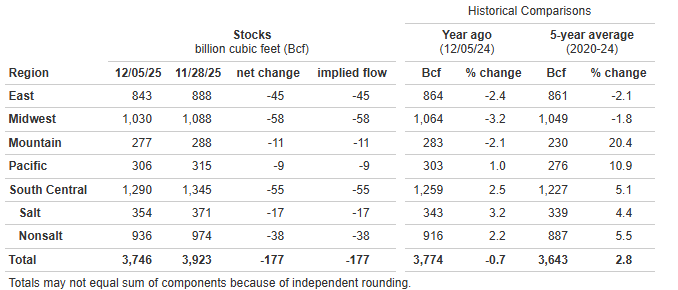
EIA Natural Gas Storage as of 12/5/25, as reported 12/11/25
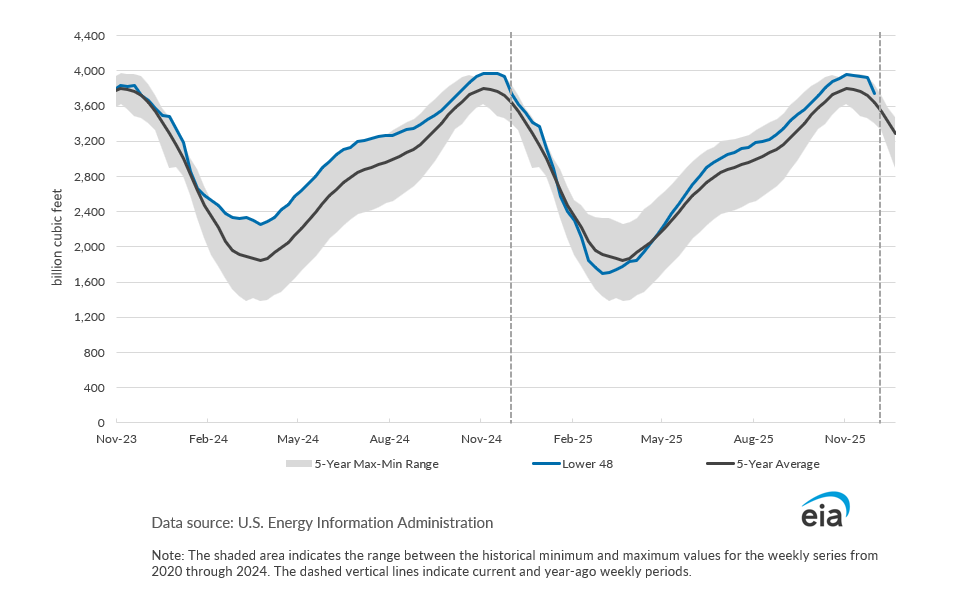
*Working gas in storage was 3,746 Bcf as of Friday, December 5, 2025, according to EIA estimates. This represents a net decrease of 177 Bcf from the previous week. Stocks were 28 Bcf less than last year at this time and 103 Bcf above the five-year average of 3,643 Bcf. At 3,746 Bcf, total working gas is within the five-year historical range.
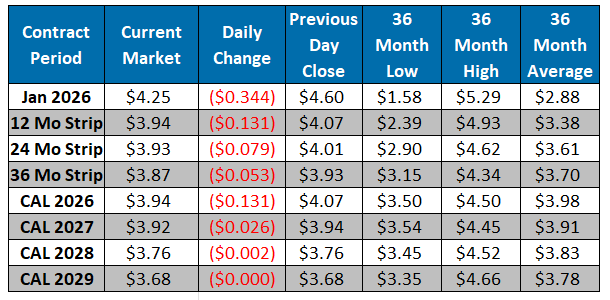
The NYMEX January contract closed at $4.60/MMBtu yesterday, a $0.02/MMBtu increase from Tuesday’s close. This week, January has averaged $4.59/MMBtu, around $0.43/MMBtu below last week’s average of $5.02/MMBtu. It is trading at $4.25/MMBtu, down $0.34/MMBtu from the previous day’s close. Natural gas prices extended their decline as a sharp warm shift in late-December forecasts weighed more heavily on sentiment than near-term cold currently supporting demand. L48 production remains robust at 108.2 – 109.2 Bcf/d, with intraday revisions lifting NE output even as Permian volumes trend lower WoW. LNG feedgas demand is exceptionally strong near 19.5 Bcf/d and averaging close to 19.8 Bcf/d over the last week, with only brief operational dips at Freeport interrupting otherwise steady export flows. Res/Comm demand is elevated as colder-than-normal temperatures persist across the East and MW, though the latest weather model runs have removed significant HDDs from 11-15 day window, signaling a broad warm-up heading into Christmas. Canadian imports have increased to 6.9-7.4 Bcf/d and should remain firm as winter weather reinforces cross-border demand over the next several weeks. Despite a sizeable storage withdrawal expected for this week, the rapid loss of heating demand in the second half of December has pressured the curve, keeping the January contract trading near the low-$4/MMBtu range as the market reassesses winter risk and awaits clearer signs of durable cold beyond the two-week horizon
*Source: U.S. Energy Information Administration (EIA) Weekly Natural Gas Storage Report
Working Gas in Underground Storage, Lower 48
Working Gas in Underground Storage vs. 5-Year Maximum and Minimum
Current Market