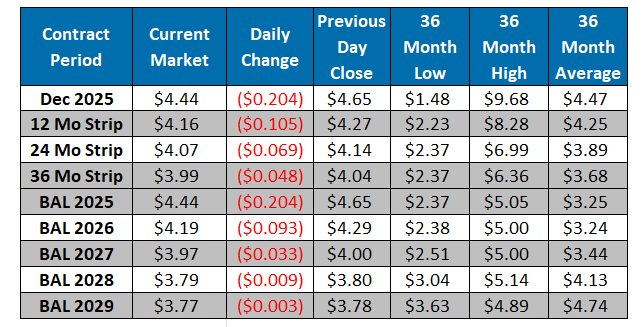
EIA Natural Gas Storage as of 11/7/25, as reported 11/14/25
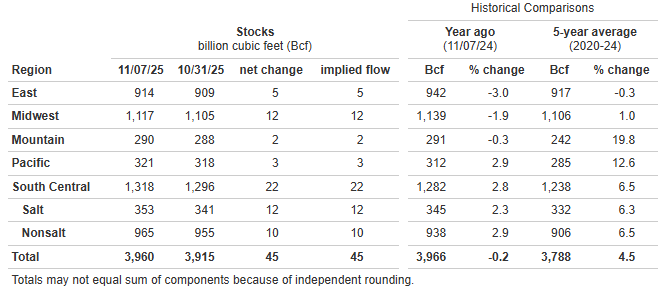
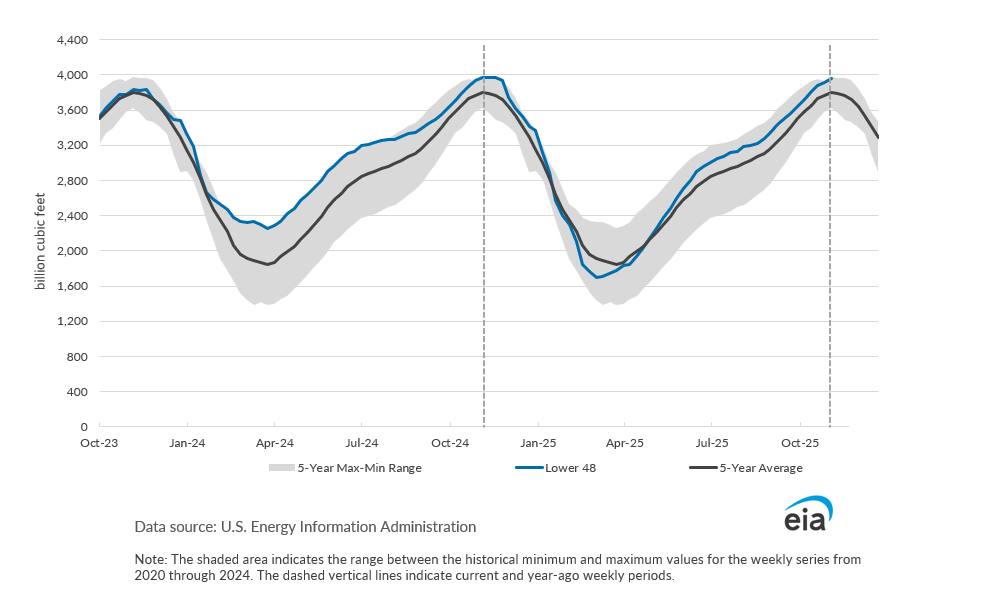
*Working gas in storage was 3,960 Bcf as of Friday, November 7, 2025, according to EIA estimates. This represents a net increase of 45 Bcf from the previous week. Stocks were 6 Bcf less than last year at this time and 172 Bcf above the five-year average of 3,788 Bcf. At 3,960 Bcf, total working gas is within the five-year historical range.
The NYMEX December contract closed at $4.65/MMBtu yesterday, a $0.11/MMBtu increase from Tuesday’s close. This week, December has averaged $4.55/MMBtu, around $0.23/MMBtu above last week’s average of $4.32/MMBtu. It is trading at $4.44/MMBtu, down $0.20/MMBtu from the previous day’s close. Natural gas prices retreated following today’s EIA storage report, which showed a 45 Bcf injection, larger than market expectations in the low-to-mid 30s. The outsized build underscored a still-loose supply/demand balance and added pressure to the front of the curve as traders continue to unwind some of the recent rally. L48 production remains elevated at 107.1-107.3 Bcf/d, supported by intraday revisions higher in the Permian and NE, leaving output roughly 6 Bcf/d above year-ago levels. LNG feedgas nominations are robust near 18.2 Bcf/d, with additional volumes flowing to CC Stage 3, which is estimated to be taking in around 0.8 Bcf/d with four of seven tarins in service. Res/Comm demand is softening as milder weather conditions weigh on heating loads, and the latest weather model guidance has removed a meaningful number of HDDs from both the 6-10- and 11-15-day windows, reinforcing a bearish late-November outlook. While a brief burst of colder weather in the NE and MW early next week should offer a temporary lift to demand, strong production, above-average storage, and a warmer second half of the month are encouraging a pullback in prices, keeping the December contract trading in the mid-$4MMBtu range as the market waits for a clearer signal from early-season cold.
*Source: U.S. Energy Information Administration (EIA) Weekly Natural Gas Storage Report
Working Gas in Underground Storage, Lower 48
Working Gas in Underground Storage vs. 5-Year Maximum and Minimum
Current Market