EIA Natural Gas Storage as of 4/3/26, as reported 4/9/26
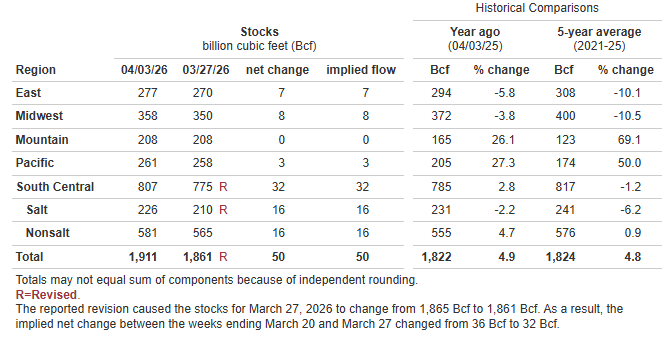
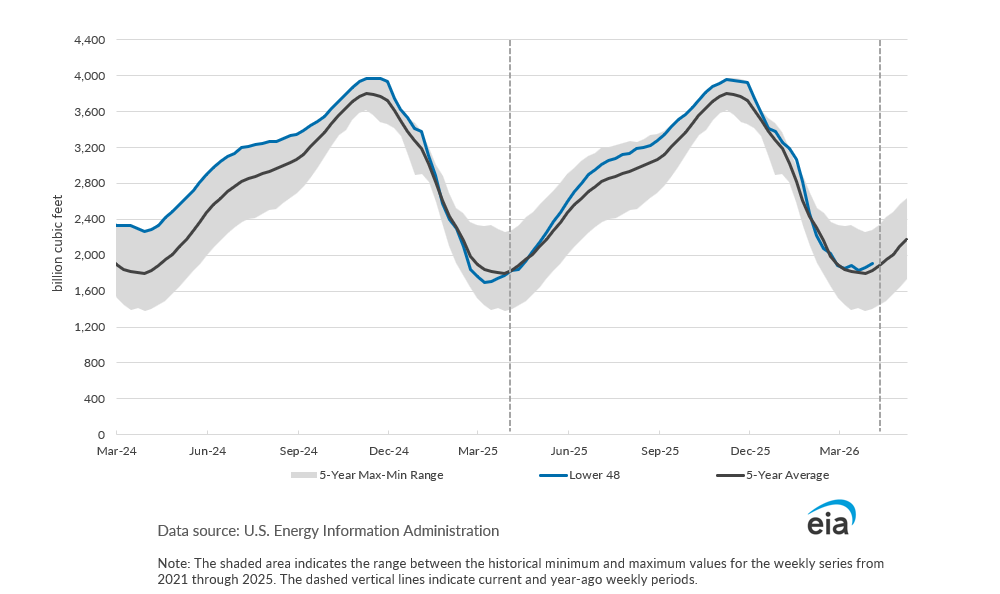
*Working gas in storage was 1,911 Bcf as of Friday, April 3, 2026, according to EIA estimates. This represents a net increase of 50 Bcf from the previous week. Stocks were 89 Bcf higher than last year at this time and 87 Bcf above the five-year average of 1,824 Bcf. At 1,911 Bcf, total working gas is within the five-year historical range.
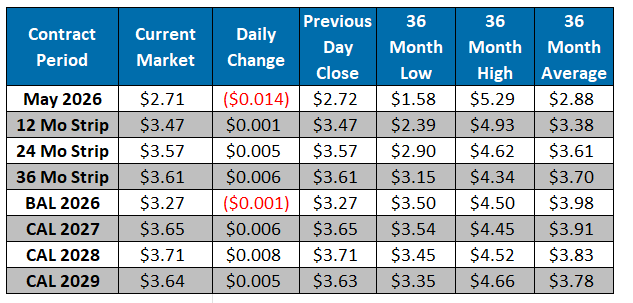
The NYMEX May contract closed at $2.72/MMBtu yesterday, a $0.15/MMBtu decrease from Tuesday’s close. This week, May has averaged $2.78/MMBtu, around $0.11/MMBtu below last week’s average of $2.88/MMBtu. It is trading at $2.71/MMBtu, down $0.01/MMBtu from the previous day’s close. Natural gas prices remain under pressure as warmer weather and easing geopolitical risk continue to weigh on the broader energy complex. L48 production is holding near 108–109 Bcf/d, with Permian maintenance limiting some volumes in the near term, though overall supply remains robust. Forecast revisions have shifted notably warmer, with both the 6–10 and 11–15 day windows pointing to rising temperatures across the East and Midwest, driving a continued decline in heating demand and an early transition toward cooling-driven demand. LNG feedgas nominations remain strong near 20 Bcf/d, though minor outages at Sabine Pass have introduced some near-term variability in flows. Mexican exports continue to hold steady near 6.5 Bcf/d, while Canadian imports have increased modestly alongside shifting regional demand patterns. ResComm demand continues to trend lower as milder conditions persist, and while cooling demand is beginning to emerge, it is not yet sufficient to offset broader demand weakness. Overall, steady supply and a rapidly warming weather outlook continue to point to a softer near-term fundamental backdrop.
*Source: U.S. Energy Information Administration (EIA) Weekly Natural Gas Storage Report
Working Gas in Underground Storage, Lower 48
Working Gas in Underground Storage vs. 5-Year Maximum and Minimum
Current Market