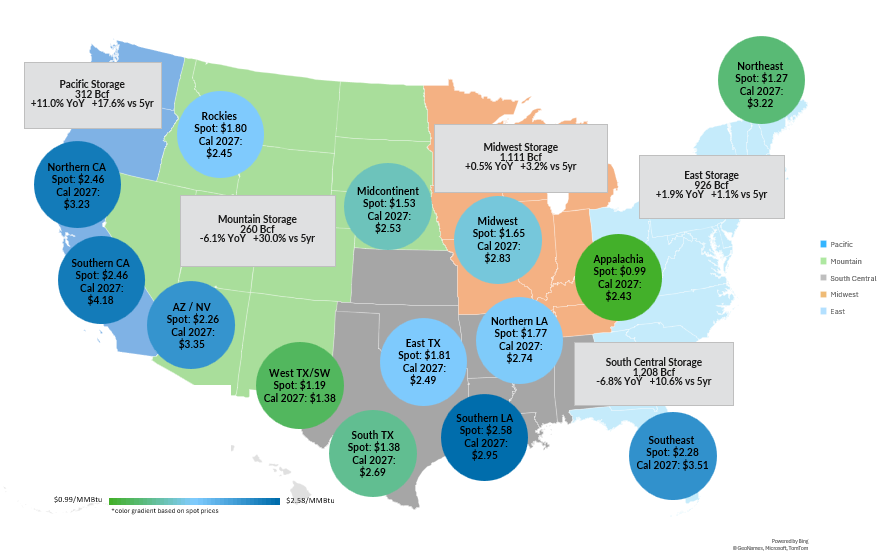
EIA Natural Gas Storage as of 10/30/26, as reported 11/05/26
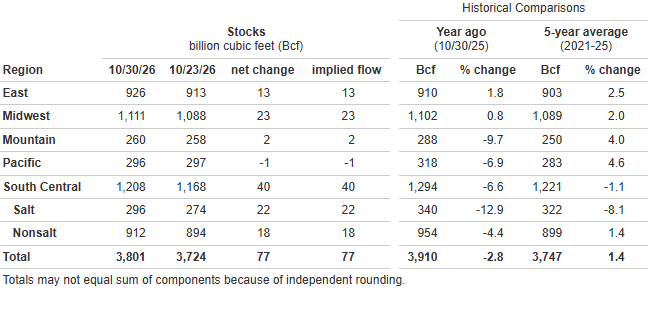
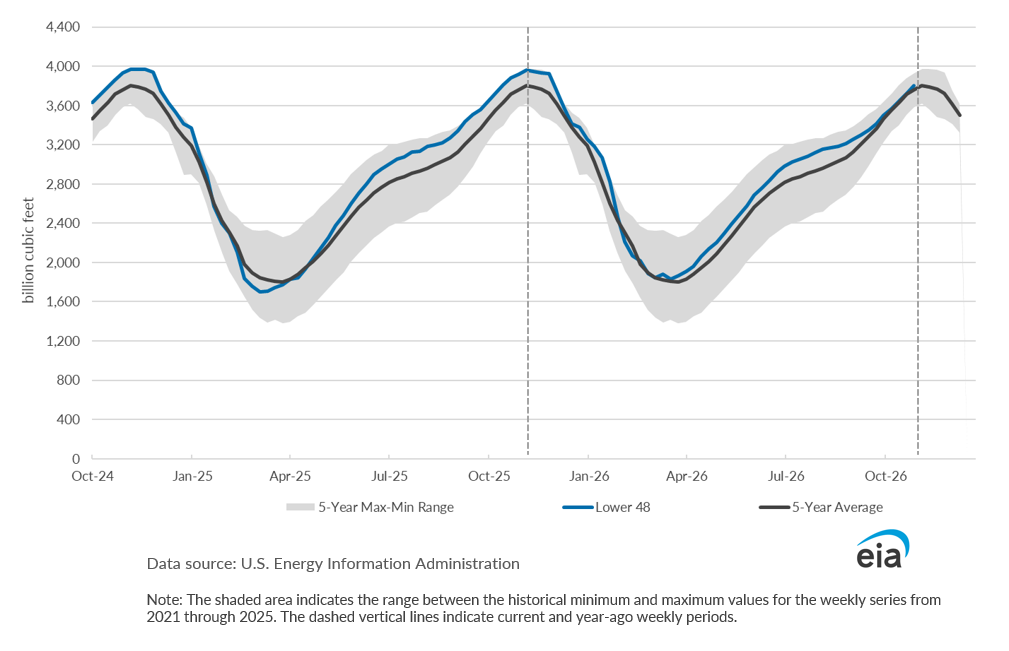
*Working gas in storage was 3,801 Bcf as of Friday, October 30, 2026, according to EIA estimates. This represents a net increase of 77 Bcf from the previous week. Stocks were 109 Bcf less than last year at this time and 54 Bcf above the five-year average of 3,747 Bcf. At 3,801 Bcf, total working gas is within the five-year historical range.
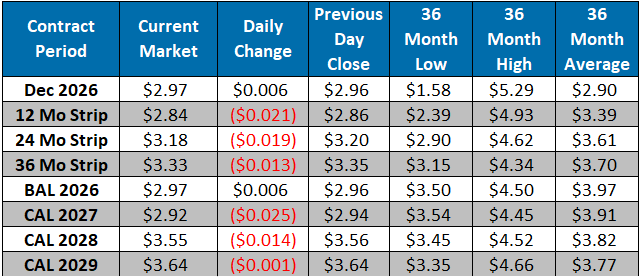
The NYMEX December contract closed at $2.959/MMBtu yesterday, a $0.06/MMBtu increase from Tuesday’s close. This week, December has averaged $2.91/MMBtu, down from last week’s $2.98 MMBtu average. It is trading at $2.969 /MMBtu, down $0.01/MMBtu from yesterday’s close. This morning’s EIA storage report showed a +77 Bcf injection for the week ending October 30. The build fell short of every major estimate: the Desk Survey (+80), the Bloomberg Survey (+81), the Bloomberg Whisper (+79) and Bank of America (+80). That makes it a bullish miss, reversing last week’s larger-than-expected build. Output has moved up to 107.8 Bcf/d, led by a 1.2 Bcf/d recovery in the Permian. In the Northeast, soft prices are still keeping 2.5–3.0 Bcf/d of supply offline compared with late October. Mild temperatures across the eastern and central US are holding heating load below normal, though demand should pick up as cooler air moves in. LNG feedgas sits at 19.7 Bcf/d and could climb to a 10-day high near 20.6 Bcf/d. Freeport’s power draw has edged up but is still only around two-thirds of capacity, and Corpus Christi flows have recovered after a two-day dip. Mexican exports are 6.9 Bcf/d, compared with a 6.4 Bcf/d average over the past week. Bank of America projects end-of-season storage at 3.886 Tcf. Any price strength over the next month or so is likely to bring curtailed volumes back online.
*Source: U.S. Energy Information Administration (EIA) Weekly Natural Gas Storage Report
Working Gas in Underground Storage, Lower 48
Working Gas in Underground Storage vs. 5-Year Maximum and Minimum
Current Market
Storage Map