
LNG Growth and Power Demand Tighten Gulf Coast Supply
Natural gas markets along the Gulf Coast are experiencing some of their strongest regional price premiums in years as record LNG export demand and elevated power-sector consumption tighten available supply east of Henry Hub. Cash prices at key trading hubs in Louisiana, Mississippi, Alabama, and Florida have climbed above $5/MMBtu during September, significantly higher than the low-$2 to low-$3 range seen during the same period in recent years. Southern Natural Louisiana, Florida Gas Zone 3, and Transco Zone 4 have all posted average prices near or above $5.70/MMBtu, reflecting growing competition for Gulf Coast gas supplies.
A major catalyst behind the price rally has been the return of LNG export demand following the completion of maintenance at Freeport LNG. Feedgas deliveries to Gulf Coast export terminals increased sharply in late August, helping push regional LNG demand to an average of approximately 18.7 Bcf/d in September. Additional volumes flowing to facilities such as Corpus Christi, Golden Pass, and Plaquemines LNG have further increased competition for available natural gas supplies across Texas and Louisiana.
Strong power generation demand has amplified the supply squeeze. Gas-fired power burn across the Texas-Louisiana Gulf Coast region has averaged roughly 8.6 Bcf/d this month, exceeding recent seasonal norms as late-summer heat continues to drive electricity consumption. As more gas is consumed locally by LNG facilities and power generators, flows moving eastward into the Southeast have declined, tightening supply conditions in downstream markets and contributing to higher spot prices.
Southeast Markets Face Structural Premiums
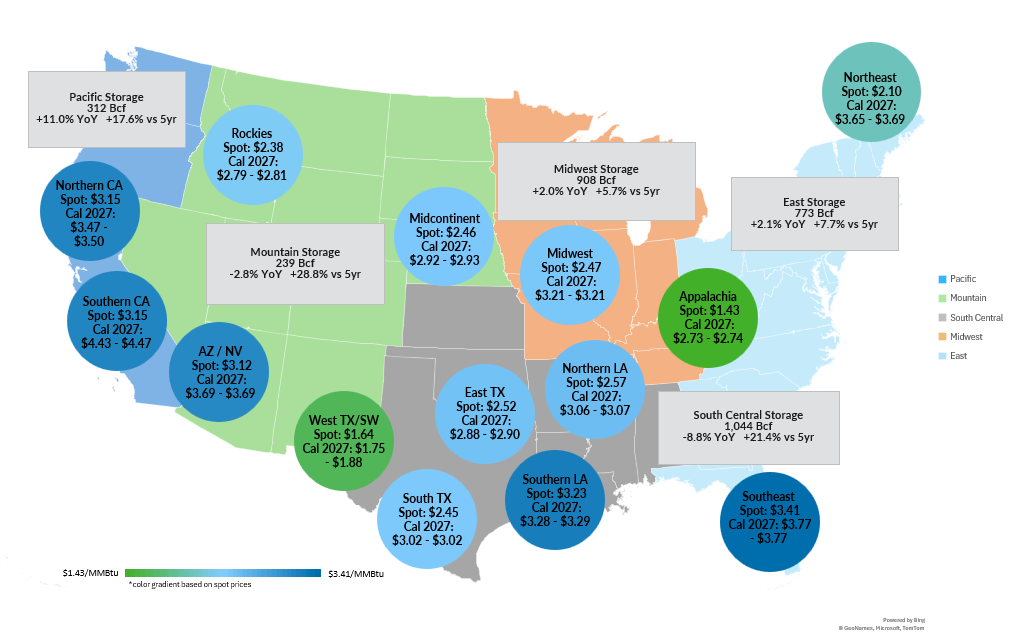
The regional dynamics are also reflected in broader basis markets. While the number of U.S. trading hubs priced above Henry Hub has fallen to 10 in September—consistent with the typical seasonal decline heading into autumn—the Southeast and Gulf Coast remain notable exceptions. Florida Gas Transmission Citygate has posted the largest premium in the country, averaging nearly $7/MMBtu and more than $4 above Henry Hub. Other Southeast hubs, including Florida Gas Zone 3, Transco Zones 3 and 4, Southern Natural, and Tennessee Line 500, have all maintained unusually strong premiums as utilities compete with LNG export facilities for limited Gulf Coast supply.
Southeast U.S. natural gas forward prices are poised to stay structurally elevated relative to Henry Hub as LNG feedgas demand along the Texas and Louisiana Gulf Coast continues to rise. As new LNG capacity pulls more Gulf molecules westward, the Southeast loses flexible inflows it has historically relied on. This tightening is amplified by pipeline expansions that increasingly direct East Texas and Haynesville gas toward LNG terminals rather than into Southeast demand centers. Even in a nationally oversupplied environment driven by strong Permian associated gas growth, the Southeast’s limited local production and constrained pipeline redundancy mean delivered prices remain sensitive to Gulf Coast competition for supply.
Outlook for 2027 and Beyond
Looking ahead, market participants expect some easing in cash prices but anticipate premiums will remain elevated. Forecasts call for Gulf Coast power demand to remain strong through late September, while LNG feedgas demand is expected to stay near record levels. Forward markets suggest prices at major Southeast hubs could retreat from current spot levels but still remain well above Henry Hub, highlighting the market’s expectation that regional supply constraints will persist.
At the same time, higher storage withdrawals this year reduce the inventory cushion heading into 2027, leaving the region more exposed during peak power burn and winter demand. With storage balances expected to narrow toward historical averages, any incremental tightening in Gulf Coast supply—whether from LNG feedgas spikes, weather disruptions, or industrial demand—translates directly into Southeast basis widening. Without increased pipeline capacity from the Northeast or Gulf Coast, the combined effect of stronger LNG takeaway and thinner storage carryout suggests Southeast hubs will maintain a premium of roughly $0.30–$0.60/MMBtu or higher above Henry Hub, with upside risk during periods of volatility.
Together, these trends underscore how rapidly expanding LNG exports and sustained electricity demand are reshaping regional gas flows and pricing dynamics. While Henry Hub remains the nation’s benchmark, growing competition for Gulf Coast supply is increasingly influencing delivered gas costs across the Southeast, creating a market environment where regional basis premiums may become a more persistent feature rather than a seasonal anomaly.