
In early April, the U.S. Department of Commerce announced that it is commencing an anti-dumping circumvention investigation into the import of solar panels from four Asian countries: Cambodia, Malaysia, Thailand, and Vietnam. The investigation was prompted by a petition from a domestic solar panel manufacturer, California’s Auxin, alleging that panel manufacturers in the four countries in question are building solar panels using Chinese components to circumvent anti-dumping tariffs that have been in place on Chinese panel imports since 2012. The investigation, and possible tariffs that could result, have upended the U.S. solar industry in recent weeks.
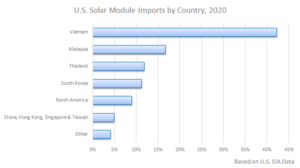
According to EIA data, imports from the four countries under investigation represented more than 70% of solar panel imports into the U.S. in 2020. These countries saw significant growth in export volumes to the U.S. in the years following the imposition of anti-dumping tariffs on Chinese panels. That growth is now threatened by the potential for tariffs to be applied to imports from those countries as well. U.S. solar panel imports in 2020 totaled nearly 22,000 MW of overall generating capacity, while domestic manufacturers produced about 5,000 MW of panels. Imports for 2021 are expected to have grown 10-15% and were poised for similar growth in 2022 given the strong demand for solar projects in the U.S. power market.
 The announcement of the investigation by the Department of Commerce came as a surprise to most in the solar power industry. A similar petition was submitted to the Department of Commerce in 2021; however, it was rejected, and industry observers expect a similar outcome for the Auxin petition. Auxin Solar is a small producer of panels, representing only about 3% of domestic production of solar panels. Despite its small output, Auxin is likely to have a lasting impact on the U.S. solar industry.
In terms of fallout from the announcement, the solar industry is just beginning to assess cost and project timeline impacts to solar farms in development. Just the uncertainty of the investigation is likely to have a significant immediate impact on panel imports from the four affected countries. Investigations like this typically take one year or more, leading to a lasting period of uncertainty for the industry. Under U.S. trade law, any tariffs that are ultimately levied on imported panels from the four countries can be retroactively applied to the date of initiation of an investigation. That means that many developers with orders for panels from the four impacted countries are now likely to halt shipments to avoid the risk of being hit with tariffs retroactively. This will likely result in delays and the potential for higher costs for projects currently being developed, as panels will need to be sourced from other suppliers outside of the impacted countries. Unfortunately, only China has manufacturing capacity to fill this supply gap, and imports of panels from China are already subject to significant tariffs.
Longer term, if the investigation leads to the imposition of tariffs, those tariffs could range from 50% to 250% which would crush the import market from the four affected countries. The global solar panel industry would need time to adjust to this new reality, and in the interim, panel costs in the U.S. would likely move substantially higher.
The vast majority of the U.S. solar industry has voiced strong opposition to the investigation. The Solar Energy Industries Association (SEIA), a large solar trade group, has been unambiguous about the negative effects on the U.S. solar industry. “This misstep will have a devastating impact on the U.S. solar market at a time when solar prices are climbing, and project delays and cancellations are adding up,” Abigail Ross Hopper, president and CEO of SEIA, said in a statement. Headwinds in the development of solar projects persisted prior to the announcement, with costs for system components like panels and steel increasing, labor costs increasing, and borrowing costs on the rise. Project development has been further challenged by delays from utilities and grid operators in handling the interconnection process for the flood of new projects in many regions. The investigation adds another significant headwind against a backdrop of strong demand for new solar generation from utilities and corporate buyers.