
DOE Authorizes Backup Generation as PJM Faces Tight Operating Conditions
The U.S. Department of Energy (DOE) issued an emergency order Oct. 12 authorizing PJM Interconnection to deploy available backup generation resources to maintain reliable electric service during a period of elevated demand and significant generation and transmission outages. The order, issued under Section 202(c) of the Federal Power Act at PJM’s request, was effective Oct. 13-16 and allows backup generators to operate without violating certain environmental requirements. PJM cited nearly 62,000 MW of expected generation outages, along with transmission constraints and firm electricity export obligations, as factors reducing its operating flexibility. The grid operator forecast demand of approximately 111,500 MW or higher on Oct. 13 and warned that reserves could fall within 900 MW of its required margin on Oct. 14. The order marks at least the second time in 2026 that DOE has granted PJM similar emergency relief, following a May 18 order.
High Demand and Maintenance Outages Increase Seasonal Reliability Concerns
PJM’s emergency request underscores the reliability challenges that can emerge during spring and fall, when planned maintenance often removes generation and transmission equipment from service just as unseasonable temperatures drive electricity demand higher. The grid operator issued a capacity advisory for Oct. 12-14 and identified the Washington, D.C., northern Virginia and Baltimore areas as particularly challenging. Potential emergency measures included transmission loading relief, recalling off-system power sales and deploying demand response resources. These actions could help preserve system reserves but may also limit electricity exports to neighboring regions and increase the importance of demand-side flexibility. The North American Electric Reliability Corp. has similarly warned that shoulder seasons can present reliability risks when abnormal heat coincides with maintenance outages and reduced operating reserves.
Record September Heat Drives Electricity Demand Higher Nationwide
The reliability concerns come amid an exceptionally warm late summer and early fall across the United States. September 2026 was the warmest September on record for the contiguous U.S., with an average temperature of 69.4 degrees Fahrenheit, 4.6 degrees above the 20th-century average. National cooling degree-days increased 36% year over year and finished 17% above historical norms, while third-quarter cooling degree-days rose 16% compared with the same period in 2025. The sustained heat contributed to higher electricity demand across most major power markets. Third-quarter average load increased 9.2% in ERCOT to 70.8 GW, 7% in the California ISO to 31.9 GW and 5.1% in PJM to 106.3 GW. Peak demand also increased across every major market, with CAISO recording the largest year-over-year gain at 27.8%, followed by ERCOT at 6.6% and PJM at 6.3%.
Higher Power Prices Reflect Tighter Market Conditions
Stronger demand contributed to significant year-over-year increases in September wholesale electricity prices across several markets. Average prices at MISO’s Indiana and Michigan hubs rose 89.9% and 71.9%, respectively, while PJM’s Western Hub increased 86.5% to $81.58/MWh. ERCOT’s average price climbed 22.8% to $38.39/MWh, and prices also rose in ISO New England and New York. Regional results varied, reflecting differences in weather, supply conditions and market dynamics. Meanwhile, the day-ahead Henry Hub natural gas price averaged $2.94/MMBtu, down 0.6% from September 2025. Retail electricity prices continued to put pressure on customers, rising 4.4% year over year, according to data from the U.S. Bureau of Labor Statistics. The combination of higher demand, maintenance-related outages and regional price volatility highlights the importance of monitoring wholesale market exposure and planning for periods of constrained supply.
El Niño Adds Uncertainty to the Outlook for Late 2026 and Early 2027
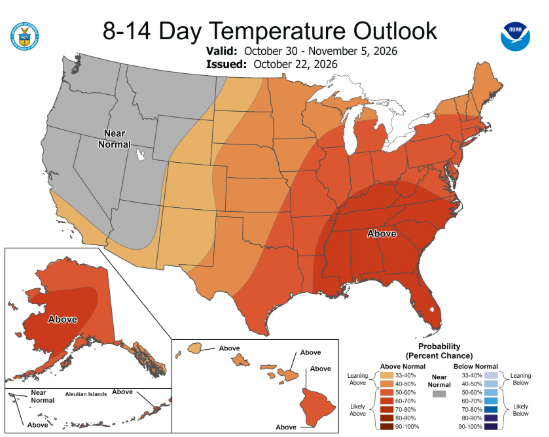
Weather forecasts indicate that above-normal temperatures could persist across much of the West, Northern Plains, Gulf Coast and Florida during October, while El Niño conditions are expected to strengthen through the end of 2026 and potentially remain strong through early 2027. Although cooler temperatures were expected to ease PJM’s immediate system stress beginning Oct. 16, the broader outlook reinforces the need for continued attention to weather-driven demand and seasonal reliability risks. For energy buyers and market participants, the developments highlight the value of evaluating forward power and natural gas exposure, demand response opportunities and contingency plans as weather patterns, planned outages and regional supply constraints interact. PJM’s latest emergency request also illustrates how periods traditionally associated with lower electricity demand can produce significant operational challenges when extreme temperatures coincide with reduced generation availability.